Guide
Machine LearningExplainer VideoData VisualizationYoutube CreatorCreating Machine Learning Explainer Videos (2026 Guide)
Data science remains one of the highest-paying career paths in the US, with median salaries exceeding $130,000. The field continues to evolve rapidly with AI and LLM integration, creating constant demand for fresh educational content. Channels like StatQuest, Ken Jee, and Krish Naik have built large audiences teaching statistics, Python, and machine learning. The niche has $18-$40 CPMs and strong course and bootcamp affiliate revenue.
By the FluxNote Editorial Team · Last updated: April 25, 2026
Step-by-Step Guide
Define your data science expertise area
Choose between statistics fundamentals, Python tooling, ML/AI tutorials, career guidance, or a specific industry application. Your professional background should inform your focus.
Create a structured learning series
Build a progressive tutorial series that takes viewers from fundamentals to practical projects. This becomes your main subscriber converter and potential paid course foundation.
Use real datasets and projects
Every tutorial should use real data and solve real problems. Kaggle datasets, government data, and API-sourced data create more valuable content than synthetic examples.
Produce portfolio project tutorials
Create end-to-end project tutorials that viewers can complete and add to their portfolios. These are the most-saved and most-shared data science content.
Build education partnerships
Join bootcamp and learning platform affiliate programs. Create honest comparisons of educational resources to help your audience make informed decisions.
The Modern Workflow for ML Explainers
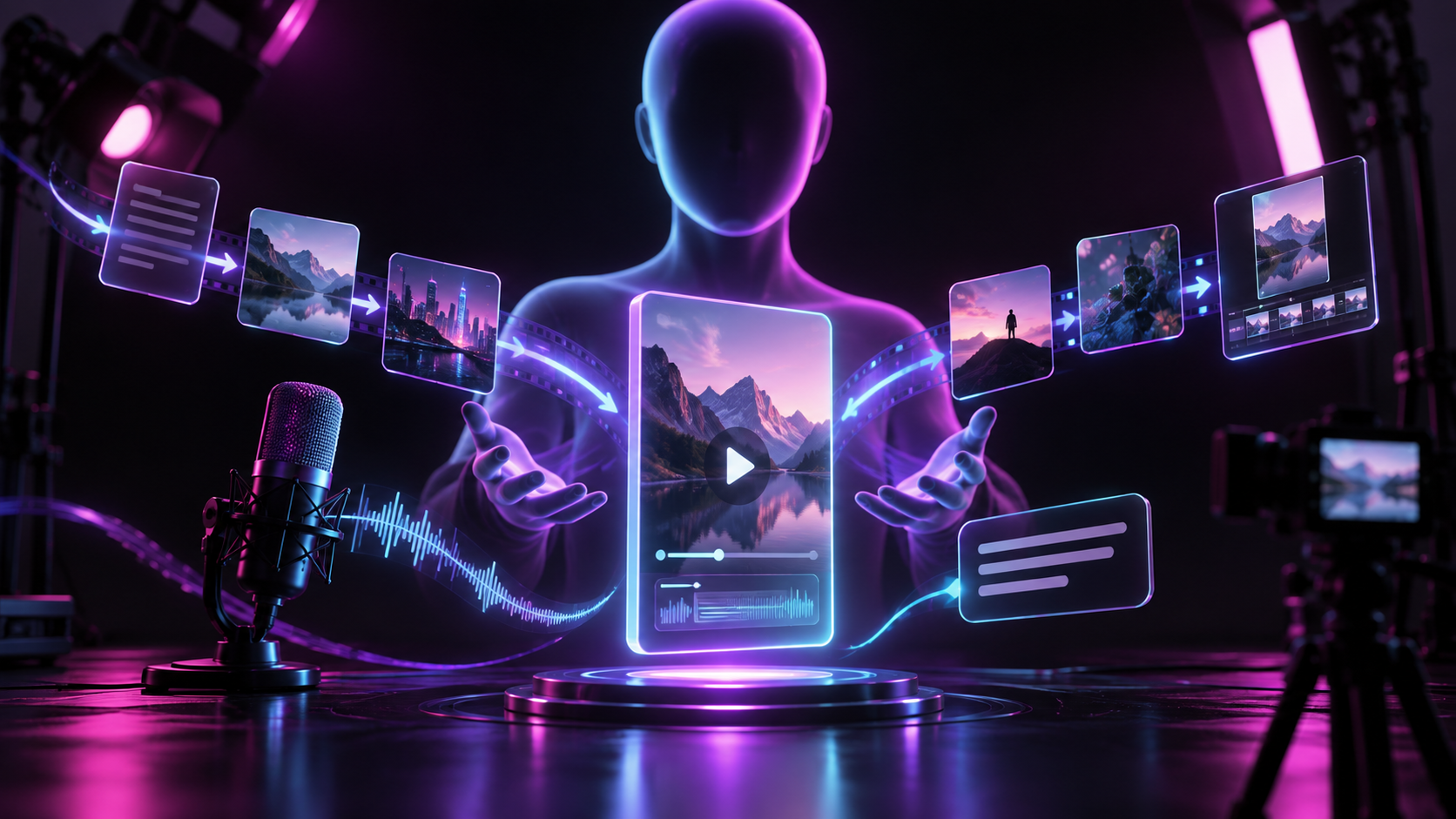
The most efficient method for creating machine learning explainer videos involves four key stages: scripting, AI voiceover generation, AI-assisted video production, and final editing.
This approach reduces manual animation work, which is the primary bottleneck.
For example, a clear script is the foundation, followed by generating a clean voice track using a tool like ElevenLabs v3, then producing visuals, and finally assembling the parts.
Start by outlining your chosen ML concept, such as a neural network layer or an activation function, into a simplified narrative. Write a script that avoids jargon where possible.
Next, feed this script into an AI voice generator to produce a high-quality audio track in minutes. With the audio ready, use a video tool to generate or select relevant visuals, like code snippets, diagrams, and stock footage, that correspond to the script's timing.
The final step is to combine these elements in a video editor, adding titles, transitions, and captions. This workflow is significantly faster than traditional screen-recording and manual animation methods.
According to a 2025 Vidyard report, educational videos with clear narration and supporting visuals see a 35% higher completion rate than text-heavy screen recordings alone.
Scripting Complex ML Concepts for Clarity
A successful explainer video depends entirely on its script. When tackling a complex topic like 'gradient descent', the goal is not to be exhaustive but to build intuition.
Use the 'Explain Like I'm 5' (ELI5) technique as a starting point. Begin with a relatable analogy, for instance, describing gradient descent as a hiker trying to find the lowest point in a valley during a foggy day, taking small steps in the steepest downward direction.
Structure your script in three parts:
- 1The Hook (0-15 seconds): State the problem or question. E.g., "How does a machine learning model actually learn? One core method is called gradient descent."
- 2The Explanation (15 seconds - 4 minutes): Use the analogy to explain the core mechanics. Introduce key terms like 'learning rate' (the size of the hiker's steps) and 'cost function' (the altitude at any point). Show, don't just tell. Plan for visuals like a simple 2D graph where a point descends along a curve.
- 3The Payoff (Final 30 seconds): Summarize the concept and state its importance. E.g., "By repeatedly taking small steps, the model minimizes its error and improves its predictions. This is the foundation of how models from simple regressions to large language models are trained."
This structure makes abstract topics digestible and keeps viewers engaged.
Comparing Visualization Tools: AI vs. Manual
Creators have three main options for visualizing ML concepts: traditional screen recording, manual animation, and AI-powered video generation.
Each has distinct trade-offs in speed, cost, and quality.
Screen recording with tools like OBS Studio is free but can be visually uninteresting and requires perfect live delivery.
Manual animation in software like Adobe After Effects offers maximum creative control but demands hundreds of hours of learning and a subscription fee of $22.99/mo (Adobe's pricing, 2026).
AI video generators present a third path, balancing speed and quality. These platforms use text prompts to create animated sequences, find stock footage, and sync everything to a voiceover.
Internal tests from 2026 show that AI tools can reduce the production time for a 5-minute explainer from over 20 hours with manual animation to under 2 hours. This efficiency allows creators to produce content more consistently.
| Method | Learning Curve | Cost (Monthly) | Time per 5-Min Video |
|---|---|---|---|
| :--- | :--- | :--- | :--- |
| Screen Recording (OBS) | Low | $0 | 1-3 Hours |
| Manual Animation (After Effects) | Very High | $22.99 | 20-50 Hours |
| AI Video Generation | Low | $10-$30 | 1-2 Hours |
Generating B-Roll and Voice with AI Platforms
AI platforms can automate the two most time-consuming parts of video creation: voiceover and visual sourcing (B-roll). For voice, tools like ElevenLabs or Play.ht can convert your script into natural-sounding audio in dozens of languages.
The standard plan for ElevenLabs costs $22/mo and includes commercial rights and access to 90+ voices (official pricing, Q1 2026). This eliminates the need for expensive microphone equipment and time spent recording and editing out mistakes.
For visuals, AI video generators work from your script.
You can input a sentence like, "The neural network processes the data through several hidden layers," and the tool will generate an abstract animation of nodes and connections or find relevant stock clips.
This is ideal for illustrating concepts where no real-world footage exists.
For instance, a tool like FluxNote can take script segments and find matching stock footage or generate simple animated scenes, syncing it with an AI-generated voiceover.
The Personal plan at $10/mo includes 10 video exports.
This process transforms a static script into a dynamic video with minimal manual effort, letting you focus on the accuracy of your explanation rather than the mechanics of video editing.
Optimizing Your Video for YouTube's Algorithm
Creating a great video is only half the work; it also needs to be discoverable.
For technical content, YouTube SEO is critical.
Start with a title that includes your core ML concept, like "Gradient Descent, Explained in 8 Minutes." In your description, provide a one-paragraph summary using keywords a beginner might search for, such as "how neural networks learn" or "machine learning basics."
Use YouTube's chapter feature to break down the video into logical parts (e.g., 0:00 Intro, 1:05 The Cost Function, 3:20 The Learning Rate).
YouTube's 2026 Creator Report shows that educational videos with chapters have a 12% higher average view duration.
A non-obvious but effective tactic is to pin a comment that links to a GitHub repository with the source code or a Colab notebook from the video.
This signals expertise and provides direct value to viewers.
Finally, create a custom thumbnail that visually represents the core concept, a simple graph or diagram is more effective than a photo of your face for these types of explainers.
Pro Tips
- Visual explanations of statistical concepts outperform code-only tutorials, invest in simple animations or whiteboard diagrams for complex topics
- Jupyter notebook walkthrough format is the standard for data science tutorials, master screen recording with clear, readable code
- Portfolio project tutorials get the most saves and shares because viewers are building their careers, make projects that actually impress hiring managers
- Cover the data cleaning and preparation process honestly, showing messy data handling builds more credibility than skipping to the 'fun' modeling part
- Interview question content spikes in hiring seasons (January-March, August-October), create interview prep content ahead of these cycles
Create Videos With AI
From inspiration to your own creation
Put your next idea into action.
Videos, images and ads. One creative studio. Pick what you want to make—or try the walkthrough before you sign up.
Your ideas. Your videos. No camera required.
Turn your next story into a faceless video. Explore the workflow, then create your own in FluxNote.
- 01 Choose a style
- 02 Add your idea
- 03 Make it your own
Start with an account. Create at your own pace.
Loading walkthrough… Full-screen link below if needed.
Tool access and generation allowances depend on your plan.
Frequently Asked Questions
Related Resources
- GuideCreate SOP Videos with AI (4 Tools Tested in 2026)
- GuideCybersecurity YouTube Video Ideas: 15 Formats for 2026
- ToolText to Video AI: Turn Text Into Videos [Fast]
- ToolAI Faceless Video Generator Guide | FluxNote
- ToolAI Explainer Video Maker: Create Videos with FluxNote
- GuideCreating Faceless Tech Review Videos (A 5-Step Guide 2026)
- GuideCreate Vocabulary Learning Videos with AI (2026 Guide)