Guide
Faceless Youtube ChannelScience CommunicationVideo ProductionYoutube For EducatorsHow to Make Science Videos Without Showing Your Face
Science education is one of YouTube's most rewarding niches, with channels like Kurzgesagt, Veritasium, and Indian creators like Physics Wallah transforming how students learn. The combination of visual demonstrations, experiments, and animated explanations makes science perfect for YouTube. This guide shows you how to start.
By the FluxNote Editorial Team · Last updated: April 25, 2026
Step-by-Step Guide
Pick your science focus
Choose one subject (Physics, Chemistry, or Biology) and one audience level. 'Visual Physics for JEE' or 'Home Chemistry Experiments' are strong starting points.
Plan experiments or animations
If doing experiments: plan safe, reproducible experiments with common materials. If doing animations: learn basic tools like Canva or PowerPoint animations.
Set up recording
For experiments: good lighting, stable camera, multiple angles. For screen-based: OBS Studio + digital whiteboard. Good microphone is essential.
Create structured playlists
Organize content into topic playlists matching school/exam syllabi. This makes your channel a study resource students return to.
Grow through Shorts and exams
Post daily science fact Shorts for discovery. Create exam-specific content 2-3 months before major exams (boards, JEE, NEET) for seasonal traffic spikes.
4 Effective Methods for Faceless Science Videos
You can create compelling science videos for YouTube without ever appearing on camera.
The core of how to make science videos without showing your face is shifting the visual focus from a person to the information itself.
This approach is ideal for educators who value privacy or lack a professional recording setup.
There are four primary methods used by successful channels: combining stock footage with an AI voiceover, creating 2D animations, using screen recordings to explain software or data, and producing whiteboard-style explainers.
Each method replaces the need for a talking head while keeping viewers engaged.
For example, channels like Kurzgesagt have gained millions of subscribers with animated explainers.
The key is to choose a method that matches your topic's complexity and your production budget.
A simple physics explanation might work well with stock footage, while a complex biology topic could benefit from custom animation to visualize cellular processes.
Method 1: Stock Footage with AI Voiceover
This is the fastest way to produce high-quality faceless videos. The process involves writing a script and using an AI voice generator to create the narration, then pairing it with relevant stock video clips.
For science topics, you can find thousands of 4K clips on sites like Pexels and Pixabay, covering everything from lab work to space exploration. For the narration, AI voice tools like ElevenLabs offer realistic voices with monthly plans starting around $5.
The Creator plan, at about $22/month, provides commercial rights and access to professional voice cloning for more unique branding. When editing, the goal is to match the visuals to the narration precisely.
If you're explaining gravity, show an apple falling. If discussing DNA, use clips of a double helix.
This method's main advantage is its low cost and speed; you can produce a 5-minute video in under 2 hours. The primary caveat is finding unique footage that hasn't been overused by other channels.
Method 2: 2D Animation and Whiteboard Explainers
Animation is perfect for explaining abstract scientific concepts that are difficult to film. Tools like Powtoon and Vyond are designed for users without animation experience, offering drag-and-drop interfaces and libraries of pre-made assets.
These platforms are effective for visualizing complex topics like quantum mechanics or chemical reactions. For instance, you can animate electrons orbiting a nucleus to explain atomic structure.
The main trade-off is cost and time. A subscription to Vyond's Premium plan for individuals is approximately $58/month, while Powtoon's pricing can be higher.
Creating a 3-minute animation can take 6-10 hours for a beginner. Whiteboard animation, a subset of this method, is also highly effective for educational content.
Tools like VideoScribe specialize in this style, which simulates a hand drawing illustrations on a whiteboard, a format proven to hold viewer attention during technical explanations.
Method 3: Integrated AI Video Generation
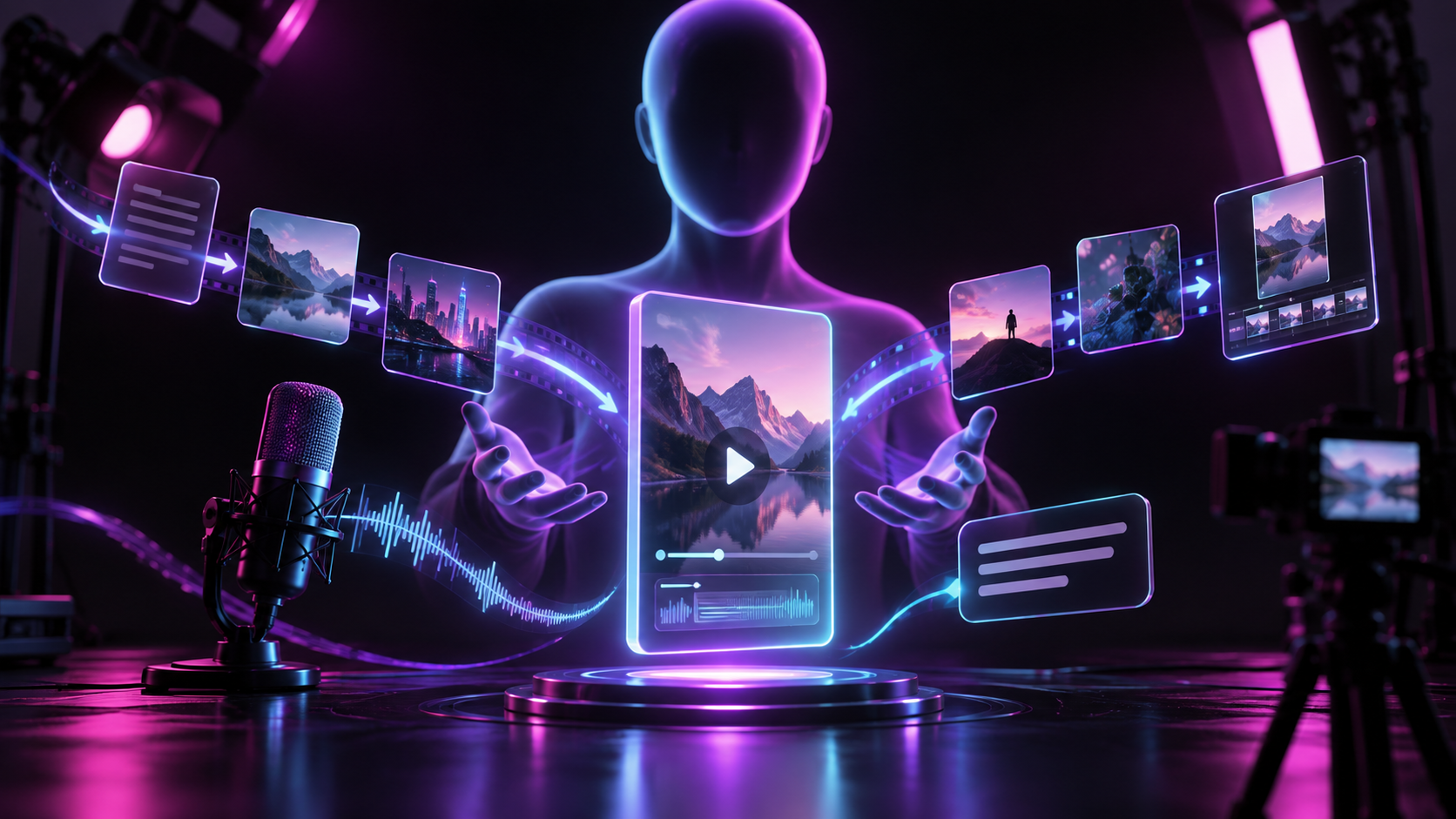
A newer approach combines the previous methods into a single workflow. AI video generators can take a script and automatically produce a complete video by selecting stock footage, generating a voiceover, and adding captions.
This drastically reduces production time compared to sourcing each element separately. For a science educator, this means you can focus entirely on script accuracy.
For example, you can input a 500-word script about the water cycle and receive a finished 3-minute video in less than 10 minutes. Some platforms offer different visual styles and voice options.
Tools in this category often have subscription plans based on video output, with many like FluxNote offering plans around $10/month for a set number of videos. This method is best for creators who need to produce content at a high frequency, such as daily science facts for YouTube Shorts or TikTok, where speed is more critical than deep customization.
Method 4: Screen Recordings and Presentations
If your science content involves software, data analysis, or walking through online resources, screen recording is the most direct method.
Using free software like OBS (Open Broadcaster Software), you can capture your screen with high fidelity.
For a crisp 1440p recording, experts recommend setting the CQP (Constant Quantization Parameter) value in OBS between 18 and 22 for a good balance of quality and file size.
This is perfect for tutorials on using astronomy software, demonstrating statistical analysis in a spreadsheet, or explaining a scientific paper on-screen.
You can also record a slideshow presentation, using a program like PowerPoint or Google Slides, and narrate over it.
A critical, non-obvious detail for this method is audio quality.
Since there is no on-screen person, the narration must be exceptionally clear.
Using a USB microphone (costing $50-$100) instead of a built-in laptop mic makes a significant difference in viewer retention.
Pro Tips
- Safety first, always demonstrate proper safety precautions in experiment videos
- Use slow-motion footage for chemical reactions and physics demonstrations, it's more dramatic and educational
- Create content aligned with exam schedules, board exam revision videos should be published October-January
- Animated diagrams get more saves than static images
- Always explain the 'why' behind experiments, not just the 'what'
Create Videos With AI
From inspiration to your own creation
Put your next idea into action.
Videos, images and ads. One creative studio. Pick what you want to make—or try the walkthrough before you sign up.
Your ideas. Your videos. No camera required.
Turn your next story into a faceless video. Explore the workflow, then create your own in FluxNote.
- 01 Choose a style
- 02 Add your idea
- 03 Make it your own
Start with an account. Create at your own pace.
Loading walkthrough… Full-screen link below if needed.
Tool access and generation allowances depend on your plan.
Frequently Asked Questions
Related Resources
- GuideHow to Make Recipe Videos for TikTok (Fast in 2026)
- GuideHow to Make Short Videos Explaining Student Loans (2026)
- ToolText to Video AI: Turn Text Into Videos [Fast]
- ToolAI Faceless Video Generator Guide | FluxNote
- GuideHow to Make UGC Videos Without Showing Your Face
- GuideHow to Make Gaming Videos Without Showing Your Face (2026)
- ToolFree AI Face Generator by FluxNote Create Realistic Faces