Guide
Youtube AutomationFaceless Youtube ChannelText To VideoAI ToolsBest AI Tool for Faceless YouTube Automation (2026 Tested)
AI tools content is 2026's fastest-growing YouTube niche. With new AI tools launching daily and businesses scrambling to adopt AI, the demand for tutorials, reviews, and use-case demonstrations is explosive. This guide shows you how to ride the AI wave on YouTube.
By the FluxNote Editorial Team · Last updated: April 25, 2026
Step-by-Step Guide
Choose your AI focus
Pick between productivity tools, creative AI, coding AI, or general reviews. Focus on tools your target audience actually needs.
Master screen recording and demos
AI content is primarily screen-recorded tutorials. Learn to record clean, well-narrated demos with OBS Studio and a good mic.
Stay ahead of new tools
Subscribe to ProductHunt, AI newsletters, and Twitter/X AI communities. Being first to review new tools captures search traffic.
Create practical use-case content
Don't just show features, show how tools solve real problems. 'How I use ChatGPT to write blog posts 5x faster' beats a feature list.
Monetize through tool affiliates
AI tool affiliates pay $10-50 per user (₹800-4,000). With YouTube ads (₹100-400/1K views) and courses, AI channels monetize well.
Key Features for Faceless YouTube Automation Tools
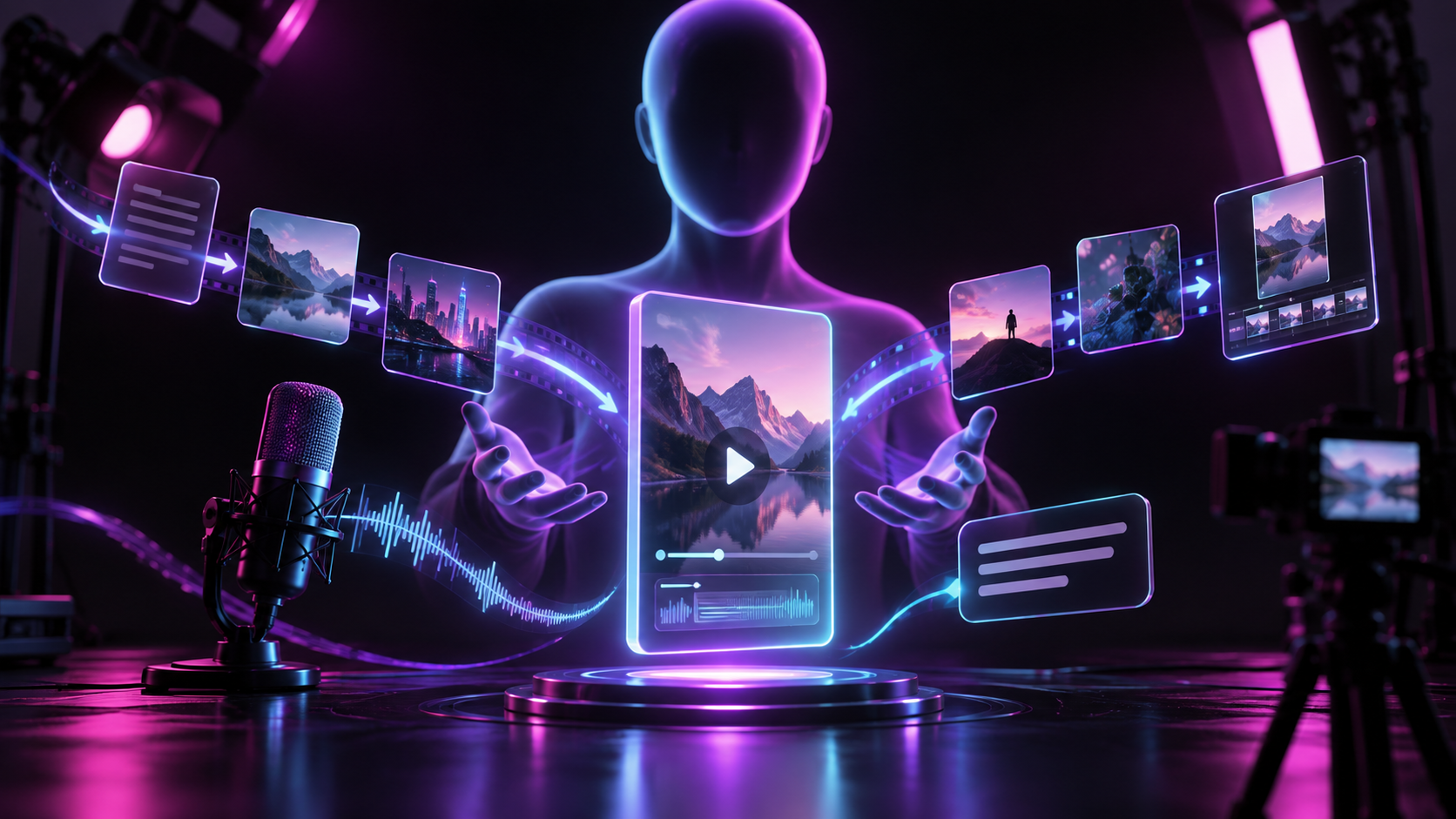
The best AI tool for faceless YouTube automation must excel at three core tasks: converting text to video, generating realistic voiceovers, and adding timed captions.
An effective platform integrates a large stock media library, often with over 1 million assets from providers like Storyblocks or Getty Images, allowing the AI to find relevant B-roll for your script automatically.
The quality of the AI voice is critical; the standard in 2026 are voices from models like ElevenLabs v3, which are nearly indistinguishable from human narration.
This integrated approach is what allows creators to reduce production time for an 8-minute video from over 4 hours of manual editing down to under 25 minutes.
Look for tools that allow bulk video creation from a CSV file or API access, which is a key feature for scaling a channel from one to five new videos per week without hiring an editor.
Text-to-Video Workflow: From Script to Final Render
A typical faceless video workflow begins with a script, often generated with a large language model like Claude 3 Sonnet or GPT-4o.
You then paste this script into the AI video tool.
The software first generates a voiceover, a process that takes about 60 seconds for a 1,200-word script.
Next, the AI analyzes the text scene-by-scene and pulls corresponding stock video clips and images to match the narration.
The most common bottleneck is correcting the AI's media choices.
Top-tier tools improve this with semantic search, allowing you to find replacement clips by describing the scene, like 'a person looking stressed at a laptop.' Once the visuals are set, the final render for a 1080p, 10-minute video typically takes between 5 and 15 minutes, depending on server load.
The entire process, including manual review, can be completed in under an hour.
Pricing Models: What to Expect from Automation Tools
AI video automation tools generally operate on a subscription model with tiered pricing. Free plans are very limited, often allowing only 1-3 video exports per month at 720p resolution and with significant feature restrictions.
Paid plans offer the necessary functionality for a YouTube channel. For instance, Pictory's Standard plan is priced at $23 per month and allows for 30 video exports.
InVideo's Plus plan costs $25 per month and includes 80 stock media downloads from iStock. A key detail to check is the number of 'AI generation credits' included.
Some platforms separate video rendering from premium voice generation, which can add an unexpected cost of $5 to $10 per month for high-quality audio. For a channel publishing consistently, a budget of $30 to $50 per month is a realistic starting point for the primary video creation tool.
Evaluating Top AI Tools for Automated Video
Different tools are built for different types of faceless channels.
For long-form, documentary-style videos that rely on converting articles to video, a platform like Pictory is a frequent choice due to its direct URL-to-video feature.
Creators who need hyper-realistic digital avatars often use Synthesia or HeyGen, though these come at a higher cost, with plans starting at $29 per month.
These are ideal for educational or corporate training content where a presenter is needed.
For channels centered on YouTube Shorts and TikTok, a tool like FluxNote is designed for that specific short-form workflow, generating captioned videos from a simple text prompt for its $10/mo plan.
The critical factor is matching the tool's core strength, be it long-form narration, avatar presentation, or short-form social clips, to your channel's content strategy.
Avoiding Common Mistakes with AI YouTube Channels
The most frequent mistake is relying 100% on AI generation without human oversight. YouTube's content policies, updated in 2025, penalize repetitive, low-value automated content.
To avoid this, always perform a manual review. Check the AI-selected footage for relevance and replace clips that don't fit the narration.
A second common pitfall is using generic, robotic-sounding AI voices. While cheaper, these voices are a major red flag for viewers and can harm audience retention, a key metric for the YouTube algorithm.
Spending an extra $5 per month for a premium, natural-sounding voice from a provider like ElevenLabs or Play.ht is a worthwhile investment. Finally, do not neglect the thumbnail.
No AI video tool currently creates compelling, high-click-through-rate thumbnails. This part of the process still requires manual creation in a tool like Canva or Photoshop to succeed.
Pro Tips
- Demo speed matters, show the tool working, don't just talk about it. Visual demonstrations convert better
- Compare tools side-by-side for the same task, viewers want to know which is best for their needs
- Create 'best free AI tools' content, it gets 3x more views than paid tool reviews
- Stay updated daily, the AI space moves so fast that week-old content can be outdated
- Build an email list of AI enthusiasts, they'll return for every new tool recommendation
Create Videos With AI
From inspiration to your own creation
Put your next idea into action.
Videos, images and ads. One creative studio. Pick what you want to make—or try the walkthrough before you sign up.
Turn your idea into a recurring series.
Explore creating and scheduling an AI-generated series in FluxNote. Choose your direction and review the setup before starting.
- 01 Choose your series
- 02 Customize the setup
- 03 Set your schedule
Start with an account. Create at your own pace.
Loading walkthrough… Full-screen link below if needed.
Tool access and generation allowances depend on your plan.
Frequently Asked Questions
Related Resources
- GuideBest AI for Sports Commentary Voice Over (2026 Tested)
- GuideBest AI Video Generator for Real Estate Listings (2026 Test)
- ToolText to Video AI: Turn Text Into Videos [Fast]
- ToolAI Faceless Video Generator Guide | FluxNote
- GuideFaceless YouTube Automation: A Guide to AI Tools (2026)
- GuideFaceless YouTube Channel Automation: A 4-Step Workflow 2026
- ToolFaceless YouTube Automation with AI | FluxNote