Guide
Faceless youtube channelEducational videosAi video generatorYoutube automationHow to Make Faceless Educational Videos (2026 Guide)
Science channels captivate curious minds. Deliver complex concepts through animated explanations, real footage, and engaging narration, no face needed.
By the FluxNote Editorial Team · Last updated: April 25, 2026
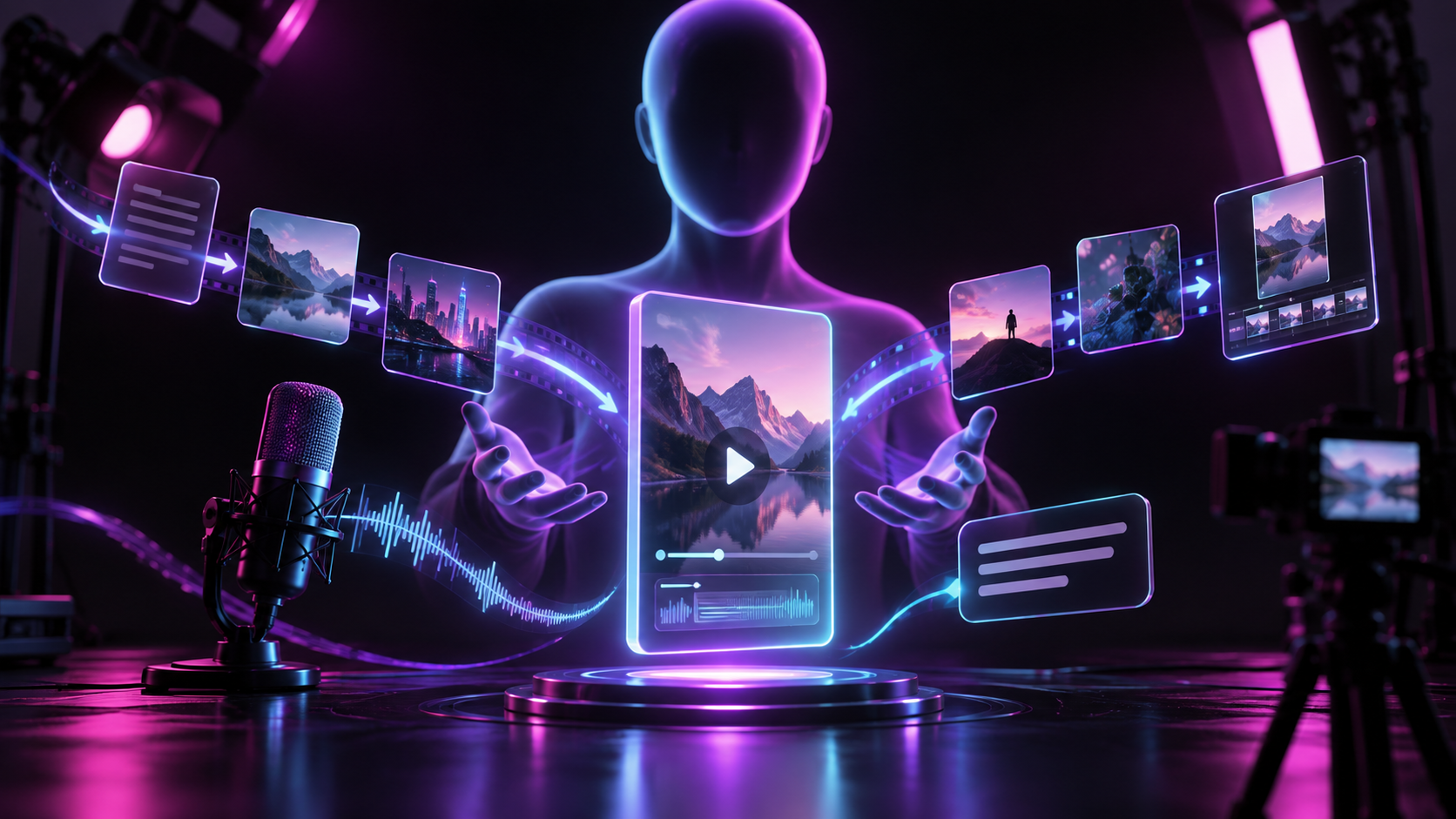
Step-by-Step Guide
Pick Your Science Focus
Choose between biology, physics, astronomy, psychology, or engineering. Dominate one area before expanding.
Research & Script Deep Dives
Read academic papers and synthesize into 1,500-2,000 word scripts. Make complex topics understandable.
Create Custom Animations
Use Blender for 3D, or simpler tools like Canva Pro for 2D explainers. Visuals make or break science content.
Record Clear Voiceovers
Use professional narration or premium text-to-speech. Clarity and pacing are critical for science education.
Build a Series & Grow Subscriptions
Create content series (e.g., 'Physics Explained', 'Biology Basics'). Series drive binge-watching and subscriber retention.
Step 1: AI-Assisted Scripting and Research
To make faceless educational videos, start with a well-structured script. Modern AI writing assistants can accelerate this process from hours to minutes.
Instead of starting from a blank page, use a tool like ChatGPT-4o or Claude 3 to generate a detailed outline. Provide a prompt such as: "Create a 5-minute video script outline for a faceless educational video explaining the greenhouse effect for a high school audience." The AI will structure the content with an introduction, key points, and a conclusion.
For factual accuracy, use a research-focused AI like Perplexity AI, which provides citations for its claims, ensuring your content is verifiable. According to a 2025 vidIQ report, videos with clear narrative structures have a 30% higher average view duration.
Once the outline is ready, you can write the full script yourself or have the AI flesh out each section. Keep sentences short and conversational for better narration flow.
A typical 5-minute video script contains between 750 and 850 words.
Step 2: Generating a Clear AI Voiceover
A high-quality voiceover is critical for faceless channels. Poor audio quality is a primary reason viewers click away.
AI voice generators now offer human-like narration without needing a microphone or recording space. Tools like ElevenLabs and Play.ht can convert your script into audio in minutes.
For educational content, choose a voice with a clear, standard accent and a moderate pace. The ElevenLabs platform (as of April 2026) offers plans starting at $5/month for 30,000 characters of audio generation.
A key detail is voice stability; use a setting between 30-50% for a natural tone without artificial emotion. Avoid using the default voice that many creators use; experiment with different voice profiles to find one that fits your channel's brand.
A non-obvious tip: generate your audio paragraph by paragraph. This makes it much easier to edit and re-generate small sections if you find a mistake, rather than re-doing the entire script.
Step 3: Sourcing and Creating Visuals
Visuals are the core of a faceless video. You have three main options: stock footage, screen recordings, or AI-generated imagery.
For many educational topics, a mix is most effective. Platforms like Pexels and Pixabay offer free, high-resolution stock videos.
For software tutorials or coding lessons, a screen recording using OBS Studio (a free, open-source tool) is the standard. The most significant development is AI-generated visuals.
Tools like Midjourney or RunwayML Gen-3 can create specific images or short video clips from text prompts. For example, you can generate a clip of "an animated DNA helix rotating on a dark background" instead of searching for stock footage.
A common mistake is using low-resolution or watermarked visuals. Always select 1080p or 4K assets.
According to a 2026 YouTube Creator report, videos uploaded in 1080p or higher receive preferential treatment in search rankings. Below is a comparison of visual sources:
| Visual Source | Cost (Monthly) | Use Case | Time Investment |
|---|---|---|---|
| Stock Footage (Pexels) | Free | General B-roll, concepts | Low |
| Screen Recording (OBS) | Free | Software tutorials, coding | Medium |
| AI Images (Midjourney) | $10+ | Custom illustrations | Medium |
| AI Video (RunwayML) | $15+ | Specific animated clips | High |
Step 4: Assembling and Editing the Video
The final step is combining your script, voiceover, and visuals into a cohesive video. You can use a traditional video editor like CapCut (free) or Adobe Premiere Pro ($22.99/mo as of 2026), but AI-powered editors are much faster for this workflow.
These tools automate the most time-consuming parts of the process. For instance, some platforms can take a script and automatically find relevant stock footage, sync it to an AI voiceover, and add animated captions.
This reduces a multi-hour editing session to under 10 minutes. When editing, ensure your visuals change every 3-5 seconds to maintain viewer engagement, a technique common in top educational channels like Kurzgesagt.
Add non-intrusive background music from a service like Epidemic Sound. A key nuance is caption styling; use bold, centered captions with a background highlight for maximum readability on mobile devices, where over 70% of YouTube content is consumed.
FluxNote is one tool that automates this entire text-to-video process, including voiceover, footage, and animated captions from a single script.
Monetization Pathways for Faceless Channels
Once your channel gains traction, you can pursue monetization. The primary route is the YouTube Partner Program (YPP), which requires 1,000 subscribers and 4,000 hours of watch time.
As of Q1 2026, the average ad revenue (RPM) for educational channels in the US is between $4 and $12 per 1,000 views. However, relying solely on AdSense is a mistake.
Diversify your income with affiliate marketing. For a science channel, this could mean including affiliate links to science kits or educational books from Amazon Associates.
Another path is creating and selling digital products, such as study guides, e-books, or short courses related to your content. A channel with 10,000 subscribers can realistically generate $200-$500 per month from AdSense, but adding affiliate links for three relevant products could add another $100-$300.
Sponsorships become viable after passing 10,000 subscribers, where brands might pay $200-$1,000 for a dedicated video or integration, depending on your niche and audience engagement.
Pro Tips
- Open with a mind-blowing fact or question to immediately engage viewers.
- Use motion graphics to break down complex processes step-by-step.
- Include real-world examples and applications to show relevance.
- Add captions for technical terms to improve comprehension.
- Partner with science educators and STEM influencers for credibility.
Create Videos With AI
From inspiration to your own creation
Put your next idea into action.
Videos, images and ads. One creative studio. Pick what you want to make—or try the walkthrough before you sign up.
Your ideas. Your videos. No camera required.
Turn your next story into a faceless video. Explore the workflow, then create your own in FluxNote.
- 01 Choose a style
- 02 Add your idea
- 03 Make it your own
Start with an account. Create at your own pace.
Loading walkthrough… Full-screen link below if needed.
Tool access and generation allowances depend on your plan.
Frequently Asked Questions
Related Resources
- GuideHow to Make AI Cooking Videos for YouTube (2026 Guide)
- GuideHow to Make Motivational Shorts with AI (5 Steps, 2026)
- ToolText to Video AI: Turn Text Into Videos [Fast]
- ToolAI Faceless Video Generator Guide | FluxNote
- GuideHow to Make Faceless Educational Videos with AI (2026 Guide)
- GuideHow to Make Faceless Educational Videos for Shorts (2026)
- ToolAI Educational Video Generator [Free]