Guide
Ai video generatorFaceless youtube channelEducational contentYoutube shortsHow to Make Faceless Educational Videos with AI (2026 Guide)
Science explainer channels are among the most respected and most-watched on YouTube. Kurzgesagt, Veritasium, and Real Engineering have shown that science content works brilliantly without traditional on-camera presence. For US creators, science offers $5-$12 RPM with strong viral potential and long-tail viewership.
By the FluxNote Editorial Team · Last updated: April 25, 2026
Step-by-Step Guide
Choose your science sub-niche
Pick one area: space, biology, physics, environmental science, or technology science. A focused channel builds authority faster than covering all of science.
Build a research process
Set up alerts on Google Scholar and arXiv for your sub-niche. Follow key researchers on Twitter/X. Subscribe to science news outlets like Nature, Science, and Ars Technica for topic ideas.
Develop your visual template
Create reusable visual templates for diagrams, data charts, and title cards. Consistency in visual design builds brand recognition. Use FluxNote for stock footage and Canva for custom graphics.
Publish weekly with Shorts supplements
Post one thorough long-form video per week and one Short per day. The long-form builds your library; the Shorts drive subscriber growth and algorithm visibility.
Apply for educational sponsorships
Once you reach 10,000 subscribers, reach out to Brilliant, CuriosityStream, and similar platforms. Science channels are among their most sought-after sponsorship partners.
Step 1: Scripting and Topic Research with AI Assistants
To make faceless educational videos with AI, you must start with a script that is both accurate and engaging.
The first step is generating a topic and a detailed outline.
Use a tool like ChatGPT-4o or Claude 3 Sonnet to brainstorm subjects within your niche.
For example, a prompt like, “Generate 10 video ideas about surprising physics concepts for a 60-second YouTube Short” can provide a strong starting point.
Once you have a topic, refine it with a follow-up prompt: “Write a 150-word script for a video titled ‘The Mpemba Effect: Can Hot Water Freeze Faster Than Cold?’ aimed at a high-school audience.” The AI should produce a script with a hook, key points, and a conclusion.
For factual accuracy, especially in science content, use Perplexity AI, which cites its sources.
A typical script for a 60-second Short should be between 140 and 160 words.
This process should take no more than 15 minutes and ensures your video is structured for high audience retention before you create any visuals.
Step 2: Generating a High-Quality AI Voiceover
A clear, natural-sounding voiceover is critical for faceless content. Your audience relies on the narration to understand the material.
Leading text-to-speech platforms like ElevenLabs or Play.ht offer hyper-realistic voices that are nearly indistinguishable from human narration. The free plans often provide enough credits for several short videos per month.
For instance, ElevenLabs' free tier as of Q1 2026 offers 10,000 characters monthly. Simply paste your 150-word script into the generator, select a voice profile 'Adam' is a popular choice for educational content, and render the audio file.
Download the final product as an MP3 file. A key detail is to listen for pacing.
If the AI reads too quickly, add commas or short phrases like "...think about that..." into the script to create natural pauses. This step avoids the robotic sound common in lower-quality text-to-speech tools from 2-3 years ago and adds a professional layer to your video.
Step 3: Sourcing and Assembling Visuals
With your audio ready, the next stage is gathering visuals. Since the channel is faceless, you will rely on stock footage, animations, and on-screen text.
For high-quality, royalty-free clips, sites like Pexels and Pixabay are excellent resources. For more specific scientific or historical footage, paid platforms like Storyblocks offer a much deeper library for around $30/month.
When searching, use specific keywords like "CGI neuron firing" or "archival 1940s factory footage." An important nuance is to ensure visual consistency. If you start with a photorealistic style, maintain it throughout the video.
Mixing CGI with historical photos can be jarring. For on-screen text and simple animations, Canva or Adobe Express have free templates optimized for YouTube Shorts (1080x1920 pixels).
The goal is to match each sentence of your voiceover with a relevant, high-energy visual clip. Each clip should last between 2 to 5 seconds to maintain viewer engagement.
Step 4: Combining Audio, Visuals, and Captions
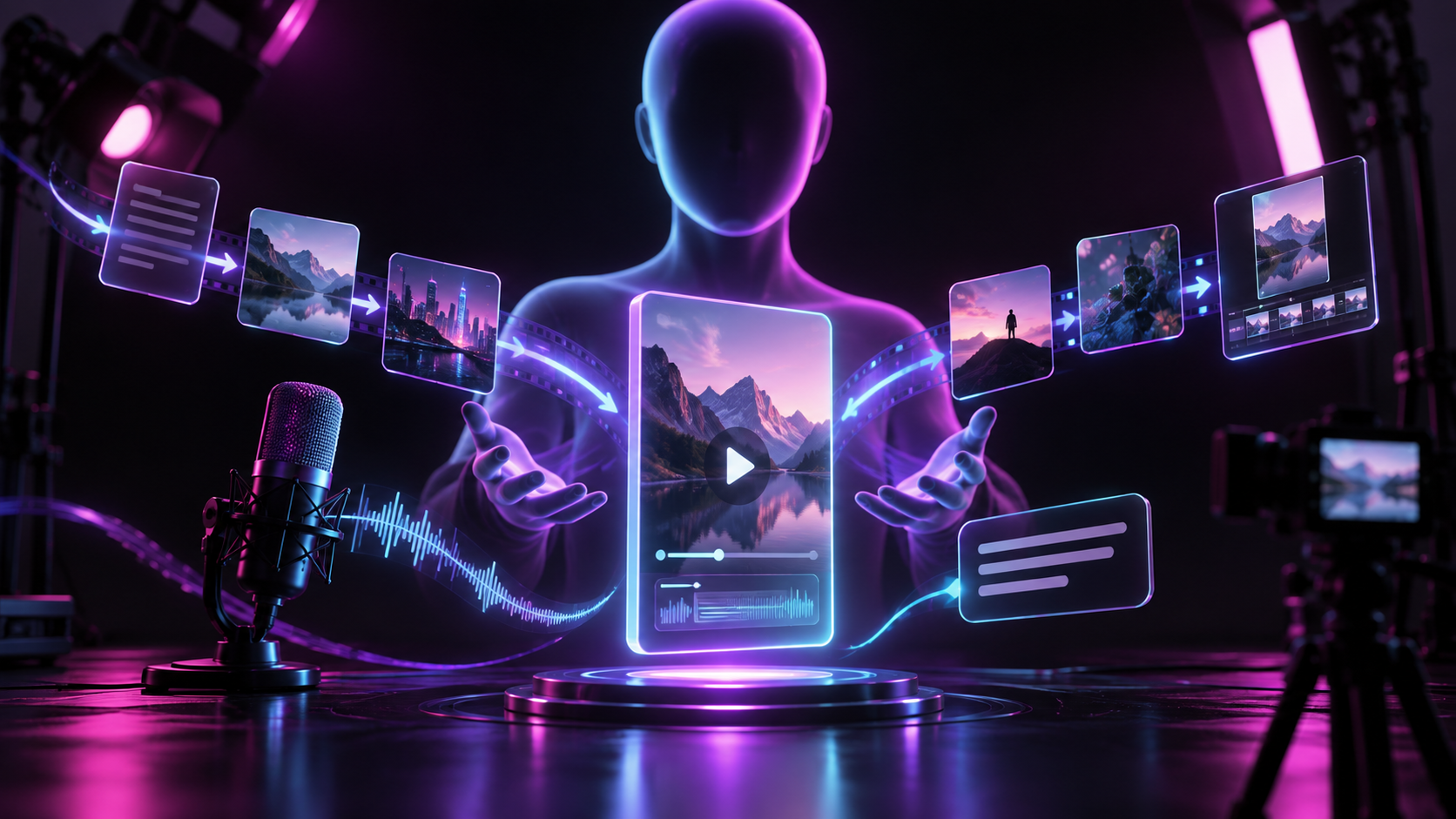
The final production step is bringing all the elements together. This is where an AI video generator dramatically speeds up the workflow.
Instead of manually syncing audio, video, and text in a complex editor like Adobe Premiere Pro, you can use a platform designed for this task. An editor like FluxNote allows you to upload your AI-generated voiceover, add your selected video clips from its integrated stock library or your own uploads, and then automatically generate synchronized captions.
Auto-captioning is essential, as studies from 2025 show over 80% of shorts are viewed without sound. The process is straightforward: create a new project, upload the MP3 voiceover, add your video clips to the timeline, and use the 'Auto-Caption' feature.
You can then customize the font and color of the captions to match your channel's branding. This integrated approach reduces the editing process from hours to less than 10 minutes.
Step 5: Final Review and YouTube Optimization
Before publishing, conduct a final review. Watch the video with and without sound to check for pacing and caption accuracy.
Ensure the first 3 seconds are visually compelling enough to stop a user from scrolling. Once satisfied, export the video in 1080p.
When uploading to YouTube, optimize the title and description. A good title follows a proven formula, like “This Physics Glitch is Real (The Mpemba Effect).” For tags, use a tool like TubeBuddy (starting at $3.60/mo) or VidIQ to find relevant keywords that actual users are searching for.
Include 5-8 tags, mixing broad terms like "#science" with specific ones like "#mpembaeffect" and "#physicsfacts." To meet YouTube's monetization requirements as of early 2026, you need 1,000 subscribers and either 4,000 watch hours on long-form videos or 10 million Shorts views in 90 days. Consistent, optimized uploads are the most direct path to achieving these milestones.
Pro Tips
- Space content consistently gets the highest view counts in science YouTube. NASA missions, black holes, and exoplanet discoveries have proven viral potential.
- Do not dumb down your content too much. Science audiences appreciate depth. If you need to simplify, acknowledge that you are simplifying and direct interested viewers to the full explanation.
- Use NASA imagery freely. It is public domain and some of the highest quality footage available anywhere. Their image and video library at images.nasa.gov is a goldmine.
- Collaborate with actual scientists. Many researchers are happy to be interviewed or consulted for YouTube videos. It adds credibility and unique perspectives.
- Cross-post to Nebula if accepted. The platform specifically supports educational creators and provides a secondary income stream.
Create Videos With AI
From inspiration to your own creation
Put your next idea into action.
Videos, images and ads. One creative studio. Pick what you want to make—or try the walkthrough before you sign up.
Your ideas. Your videos. No camera required.
Turn your next story into a faceless video. Explore the workflow, then create your own in FluxNote.
- 01 Choose a style
- 02 Add your idea
- 03 Make it your own
Start with an account. Create at your own pace.
Loading walkthrough… Full-screen link below if needed.
Tool access and generation allowances depend on your plan.
Frequently Asked Questions
Related Resources
- GuideHow to Make Faceless Amazon Affiliate Videos (2026 Guide)
- GuideHow to Make Faceless Finance Videos with AI (2026 Guide)
- GuideBest Text to Speech for Faceless YouTube Videos (2026)
- GuideAI Script Generator for History Videos: A 2026 Tested Guide
- GuideBest Faceless YouTube Niches USA 2026: $15-$50 RPM
- GuideHow to Make Faceless Educational Videos (2026 Guide)
- GuideHow to Make Faceless Educational Videos with AI (2026 Guide)